 Add to Chrome
 Add to Firefox
 Add to Edge
LARK: Learnability-Grounded Trajectory Selection for Efficient Reasoning Distillation
May 28, 2026
We study trajectory selection for reasoning distillation, where teacher-generated reasoning trajectories are selectively used as supervision for a student model. Existing methods rely on heuristics such as trajectory quality or model confidence, but they often overlook whether a trajectory is learnable by the student. In this paper, we present LARK, a learnability-grounded method for reasoning trajectory selection. LARK selects trajectories that the student can learn efficiently while preserving the generalization of the full training distribution. At the core of LARK is a learnability factor $ρ$, which characterizes the rate at which the student's training loss decreases. To estimate this rate efficiently and maintain generalization, we introduce a learnability proxy and a $χ^2$-regularized selection policy that balances learnability and distributional coverage, both with strong theoretical guarantees on their estimation error. Empirically, LARK consistently outperforms data selection baselines across multiple base models and reasoning tasks. Diagnostic analyses show that the LARK score predicts downstream training utility and that LARK-selected trajectories induce faster supervised fine-tuning loss reduction. Our code is available at https://github.com/Tianrun-Yu/LARK.

SEP-Attack: A Simple and Effective Paradigm for Transfer-Based Textual Adversarial Attack
May 24, 2026Despite the strong performance of deep neural networks in modern Web and language applications, they remain vulnerable to adversarial attacks, especially transferable attacks that generate adversarial examples using surrogate models without accessing the victim model. Transferable attacks in the text domain are still under-explored, with only a few studies addressing this challenging issue, often with suboptimal results due to equal treatment of submodels or inaccurate estimation of importance scores. To address these challenges, we propose a simple yet effective paradigm for transfer-based textual adversarial attack, named SEP-Attack. Specifically, we employ the Determinantal Point Process (DPP) to generate diverse surrogate ensemble weights, representing the transferability of submodels. Using these weights, we introduce a new metric to evaluate prediction confidence scores, which in turn are used to calculate word importance scores and generate adversarial candidates. Finally, we quantify the transferability score for each candidate and select the top ones as the final transferable adversarial examples. Experiments conducted on four datasets and two real-world APIs validate the efficacy of SEP-Attack, significantly outperforming state-of-the-art baselines.
SEPTQ: A Simple and Effective Post-Training Quantization Paradigm for Large Language Models
Apr 11, 2026Large language models (LLMs) have shown remarkable performance in various domains, but they are constrained by massive computational and storage costs. Quantization, an effective technique for compressing models to fit resource-limited devices while preserving generative quality, encompasses two primary methods: quantization aware training (QAT) and post-training quantization (PTQ). QAT involves additional retraining or fine-tuning, thus inevitably resulting in high training cost and making it unsuitable for LLMs. Consequently, PTQ has become the research hotspot in recent quantization methods. However, existing PTQ methods usually rely on various complex computation procedures and suffer from considerable performance degradation under low-bit quantization settings. To alleviate the above issues, we propose a simple and effective post-training quantization paradigm for LLMs, named SEPTQ. Specifically, SEPTQ first calculates the importance score for each element in the weight matrix and determines the quantization locations in a static global manner. Then it utilizes the mask matrix which represents the important locations to quantize and update the associated weights column-by-column until the appropriate quantized weight matrix is obtained. Compared with previous methods, SEPTQ simplifies the post-training quantization procedure into only two steps, and considers the effectiveness and efficiency simultaneously. Experimental results on various datasets across a suite of models ranging from millions to billions in different quantization bit-levels demonstrate that SEPTQ significantly outperforms other strong baselines, especially in low-bit quantization scenarios.
Enhancing Medical Large Vision-Language Models via Alignment Distillation
Dec 21, 2025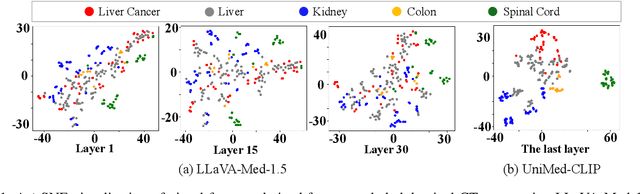
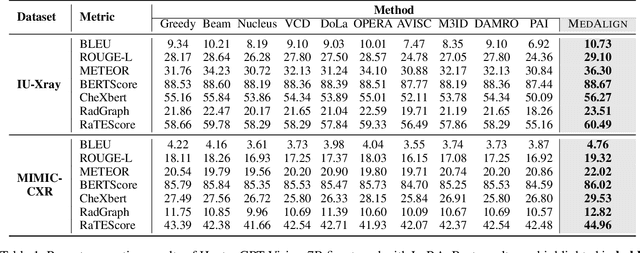
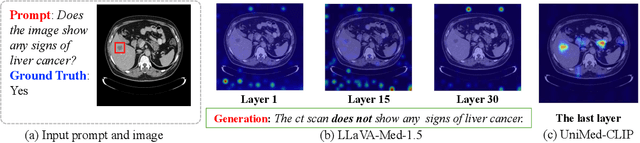
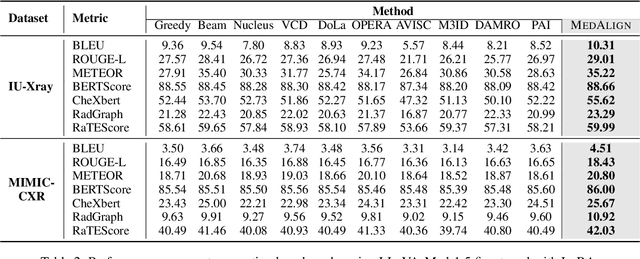
Medical Large Vision-Language Models (Med-LVLMs) have shown promising results in clinical applications, but often suffer from hallucinated outputs due to misaligned visual understanding. In this work, we identify two fundamental limitations contributing to this issue: insufficient visual representation learning and poor visual attention alignment. To address these problems, we propose MEDALIGN, a simple, lightweight alignment distillation framework that transfers visual alignment knowledge from a domain-specific Contrastive Language-Image Pre-training (CLIP) model to Med-LVLMs. MEDALIGN introduces two distillation losses: a spatial-aware visual alignment loss based on visual token-level similarity structures, and an attention-aware distillation loss that guides attention toward diagnostically relevant regions. Extensive experiments on medical report generation and medical visual question answering (VQA) benchmarks show that MEDALIGN consistently improves both performance and interpretability, yielding more visually grounded outputs.
MeCaMIL: Causality-Aware Multiple Instance Learning for Fair and Interpretable Whole Slide Image Diagnosis
Nov 14, 2025Multiple instance learning (MIL) has emerged as the dominant paradigm for whole slide image (WSI) analysis in computational pathology, achieving strong diagnostic performance through patch-level feature aggregation. However, existing MIL methods face critical limitations: (1) they rely on attention mechanisms that lack causal interpretability, and (2) they fail to integrate patient demographics (age, gender, race), leading to fairness concerns across diverse populations. These shortcomings hinder clinical translation, where algorithmic bias can exacerbate health disparities. We introduce \textbf{MeCaMIL}, a causality-aware MIL framework that explicitly models demographic confounders through structured causal graphs. Unlike prior approaches treating demographics as auxiliary features, MeCaMIL employs principled causal inference -- leveraging do-calculus and collider structures -- to disentangle disease-relevant signals from spurious demographic correlations. Extensive evaluation on three benchmarks demonstrates state-of-the-art performance across CAMELYON16 (ACC/AUC/F1: 0.939/0.983/0.946), TCGA-Lung (0.935/0.979/0.931), and TCGA-Multi (0.977/0.993/0.970, five cancer types). Critically, MeCaMIL achieves superior fairness -- demographic disparity variance drops by over 65% relative reduction on average across attributes, with notable improvements for underserved populations. The framework generalizes to survival prediction (mean C-index: 0.653, +0.017 over best baseline across five cancer types). Ablation studies confirm causal graph structure is essential -- alternative designs yield 0.048 lower accuracy and 4.2x times worse fairness. These results establish MeCaMIL as a principled framework for fair, interpretable, and clinically actionable AI in digital pathology. Code will be released upon acceptance.
Two-Stage Decoupling Framework for Variable-Length Glaucoma Prognosis
Sep 15, 2025Glaucoma is one of the leading causes of irreversible blindness worldwide. Glaucoma prognosis is essential for identifying at-risk patients and enabling timely intervention to prevent blindness. Many existing approaches rely on historical sequential data but are constrained by fixed-length inputs, limiting their flexibility. Additionally, traditional glaucoma prognosis methods often employ end-to-end models, which struggle with the limited size of glaucoma datasets. To address these challenges, we propose a Two-Stage Decoupling Framework (TSDF) for variable-length glaucoma prognosis. In the first stage, we employ a feature representation module that leverages self-supervised learning to aggregate multiple glaucoma datasets for training, disregarding differences in their supervisory information. This approach enables datasets of varying sizes to learn better feature representations. In the second stage, we introduce a temporal aggregation module that incorporates an attention-based mechanism to process sequential inputs of varying lengths, ensuring flexible and efficient utilization of all available data. This design significantly enhances model performance while maintaining a compact parameter size. Extensive experiments on two benchmark glaucoma datasets:the Ocular Hypertension Treatment Study (OHTS) and the Glaucoma Real-world Appraisal Progression Ensemble (GRAPE),which differ significantly in scale and clinical settings,demonstrate the effectiveness and robustness of our approach.
Rethinking Contrastive Learning in Session-based Recommendation
Jun 05, 2025
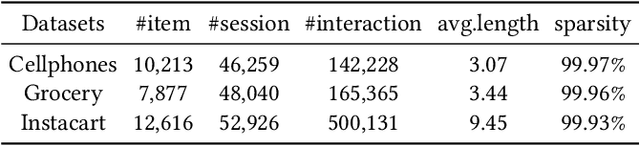
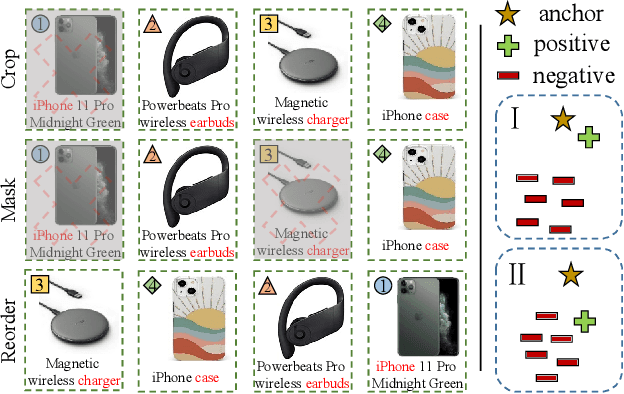
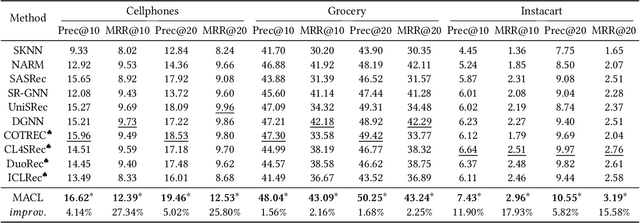
Session-based recommendation aims to predict intents of anonymous users based on limited behaviors. With the ability in alleviating data sparsity, contrastive learning is prevailing in the task. However, we spot that existing contrastive learning based methods still suffer from three obstacles: (1) they overlook item-level sparsity and primarily focus on session-level sparsity; (2) they typically augment sessions using item IDs like crop, mask and reorder, failing to ensure the semantic consistency of augmented views; (3) they treat all positive-negative signals equally, without considering their varying utility. To this end, we propose a novel multi-modal adaptive contrastive learning framework called MACL for session-based recommendation. In MACL, a multi-modal augmentation is devised to generate semantically consistent views at both item and session levels by leveraging item multi-modal features. Besides, we present an adaptive contrastive loss that distinguishes varying contributions of positive-negative signals to improve self-supervised learning. Extensive experiments on three real-world datasets demonstrate the superiority of MACL over state-of-the-art methods.
Focus on What Matters: Enhancing Medical Vision-Language Models with Automatic Attention Alignment Tuning
May 24, 2025Medical Large Vision-Language Models (Med-LVLMs) often exhibit suboptimal attention distribution on visual inputs, leading to hallucinated or inaccurate outputs. Existing mitigation methods primarily rely on inference-time interventions, which are limited in attention adaptation or require additional supervision. To address this, we propose A$^3$Tune, a novel fine-tuning framework for Automatic Attention Alignment Tuning. A$^3$Tune leverages zero-shot weak labels from SAM, refines them into prompt-aware labels using BioMedCLIP, and then selectively modifies visually-critical attention heads to improve alignment while minimizing interference. Additionally, we introduce a A$^3$MoE module, enabling adaptive parameter selection for attention tuning across diverse prompts and images. Extensive experiments on medical VQA and report generation benchmarks show that A$^3$Tune outperforms state-of-the-art baselines, achieving enhanced attention distributions and performance in Med-LVLMs.
Robustifying Vision-Language Models via Dynamic Token Reweighting
May 22, 2025Large vision-language models (VLMs) are highly vulnerable to jailbreak attacks that exploit visual-textual interactions to bypass safety guardrails. In this paper, we present DTR, a novel inference-time defense that mitigates multimodal jailbreak attacks through optimizing the model's key-value (KV) caches. Rather than relying on curated safety-specific data or costly image-to-text conversion, we introduce a new formulation of the safety-relevant distributional shift induced by the visual modality. This formulation enables DTR to dynamically adjust visual token weights, minimizing the impact of adversarial visual inputs while preserving the model's general capabilities and inference efficiency. Extensive evaluation across diverse VLMs and attack benchmarks demonstrates that \sys outperforms existing defenses in both attack robustness and benign task performance, marking the first successful application of KV cache optimization for safety enhancement in multimodal foundation models. The code for replicating DTR is available: https://anonymous.4open.science/r/DTR-2755 (warning: this paper contains potentially harmful content generated by VLMs.)
MEDMKG: Benchmarking Medical Knowledge Exploitation with Multimodal Knowledge Graph
May 22, 2025Medical deep learning models depend heavily on domain-specific knowledge to perform well on knowledge-intensive clinical tasks. Prior work has primarily leveraged unimodal knowledge graphs, such as the Unified Medical Language System (UMLS), to enhance model performance. However, integrating multimodal medical knowledge graphs remains largely underexplored, mainly due to the lack of resources linking imaging data with clinical concepts. To address this gap, we propose MEDMKG, a Medical Multimodal Knowledge Graph that unifies visual and textual medical information through a multi-stage construction pipeline. MEDMKG fuses the rich multimodal data from MIMIC-CXR with the structured clinical knowledge from UMLS, utilizing both rule-based tools and large language models for accurate concept extraction and relationship modeling. To ensure graph quality and compactness, we introduce Neighbor-aware Filtering (NaF), a novel filtering algorithm tailored for multimodal knowledge graphs. We evaluate MEDMKG across three tasks under two experimental settings, benchmarking twenty-four baseline methods and four state-of-the-art vision-language backbones on six datasets. Results show that MEDMKG not only improves performance in downstream medical tasks but also offers a strong foundation for developing adaptive and robust strategies for multimodal knowledge integration in medical artificial intelligence.